> ## Documentation Index
> Fetch the complete documentation index at: https://docs.crewai.com/llms.txt
> Use this file to discover all available pages before exploring further.
# Flows in Studio
> Build event-driven workflows that combine deterministic, step-by-step control with agentic intelligence — no code required.
**Rolling out now**: Flows in Studio is being rolled out gradually during the week of July 20th, 2026. If you don't see the Flows option in Studio yet, it hasn't reached your organization — check back soon.
## Overview
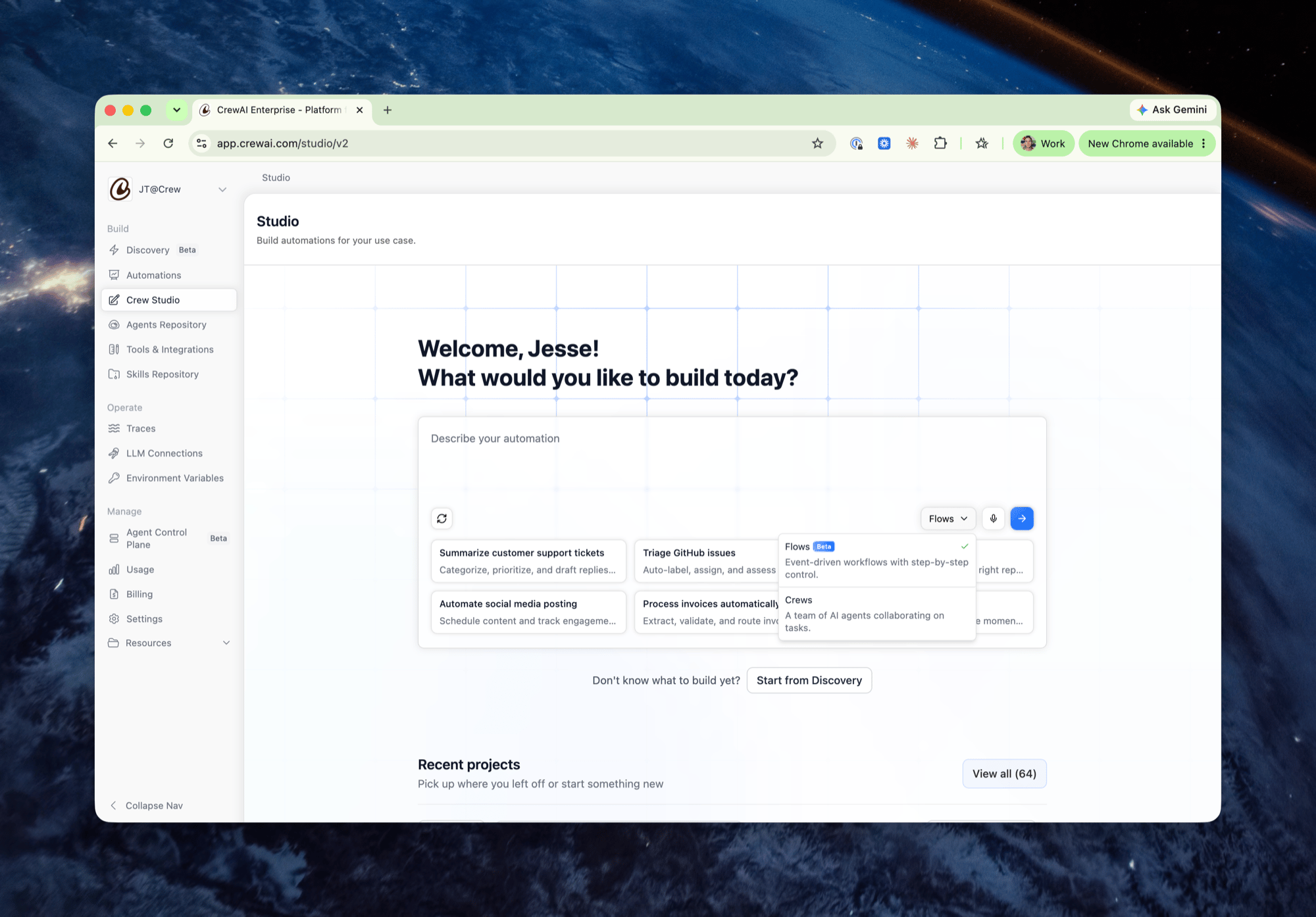
Studio now supports building **Flows** in addition to Crews. Flows are event-driven workflows where you control exactly which steps run, in what order, and under what conditions — while still delegating the intelligent work within each step to AI agents.
To build a Flow, open Studio, describe your automation, and select **Flows** from the selector next to the prompt box.
 ## Why Flows?
Crews are great when you want a team of agents to collaborate autonomously toward a goal. But many real-world automations need more predictability: fetch this data first, then summarize it, then post the result — every time, in that order.
Flows give you both:
* **Determinism where it matters**: steps execute in a defined sequence with explicit branching, so runs are predictable, repeatable, and easy to debug.
* **Intelligence where you need it**: each step is powered by an agent (or an entire crew), so the work inside a step — summarizing, scoring, drafting, deciding — benefits from full LLM reasoning.
This mix is what makes Flows well suited for production automations: the structure is guaranteed, and the agency is scoped to the steps that need it.
## Building a Flow
Describe what you want in natural language and the Studio Assistant designs the Flow for you — creating the steps, wiring them together, and configuring the agents and app integrations each step needs. The canvas on the right shows the resulting workflow as connected nodes, and you can keep iterating conversationally or edit any node directly.
## Why Flows?
Crews are great when you want a team of agents to collaborate autonomously toward a goal. But many real-world automations need more predictability: fetch this data first, then summarize it, then post the result — every time, in that order.
Flows give you both:
* **Determinism where it matters**: steps execute in a defined sequence with explicit branching, so runs are predictable, repeatable, and easy to debug.
* **Intelligence where you need it**: each step is powered by an agent (or an entire crew), so the work inside a step — summarizing, scoring, drafting, deciding — benefits from full LLM reasoning.
This mix is what makes Flows well suited for production automations: the structure is guaranteed, and the agency is scoped to the steps that need it.
## Building a Flow
Describe what you want in natural language and the Studio Assistant designs the Flow for you — creating the steps, wiring them together, and configuring the agents and app integrations each step needs. The canvas on the right shows the resulting workflow as connected nodes, and you can keep iterating conversationally or edit any node directly.
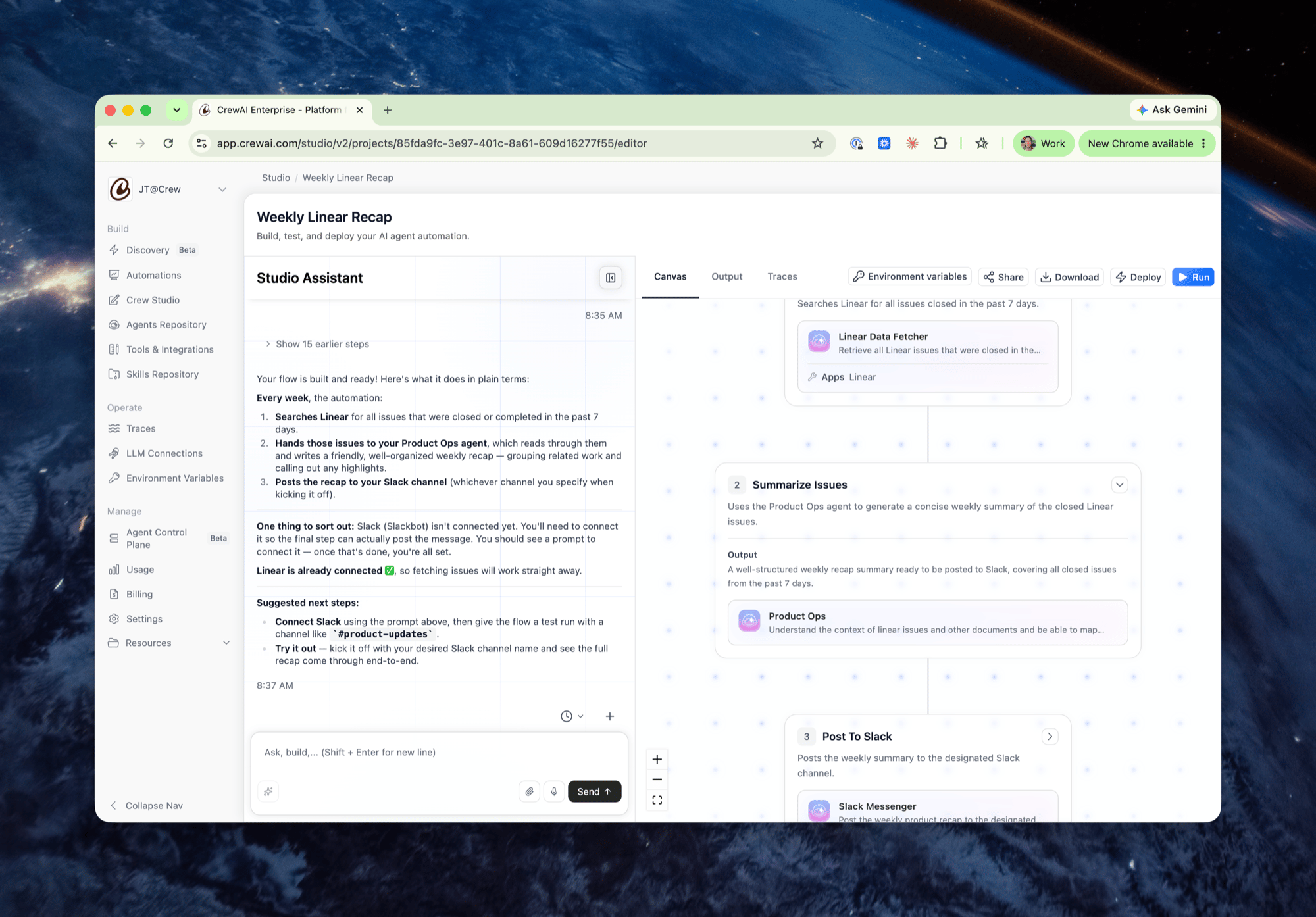 When you're ready, use **Run** to test the Flow end-to-end, inspect results in the **Output** and **Traces** tabs, and **Deploy** when it's stable. You can also **Share** the project or **Download** the source code.
## Node Types
Flows are composed from three core node types. Each node is a step in the workflow, and you can mix them freely.
### Single Agent
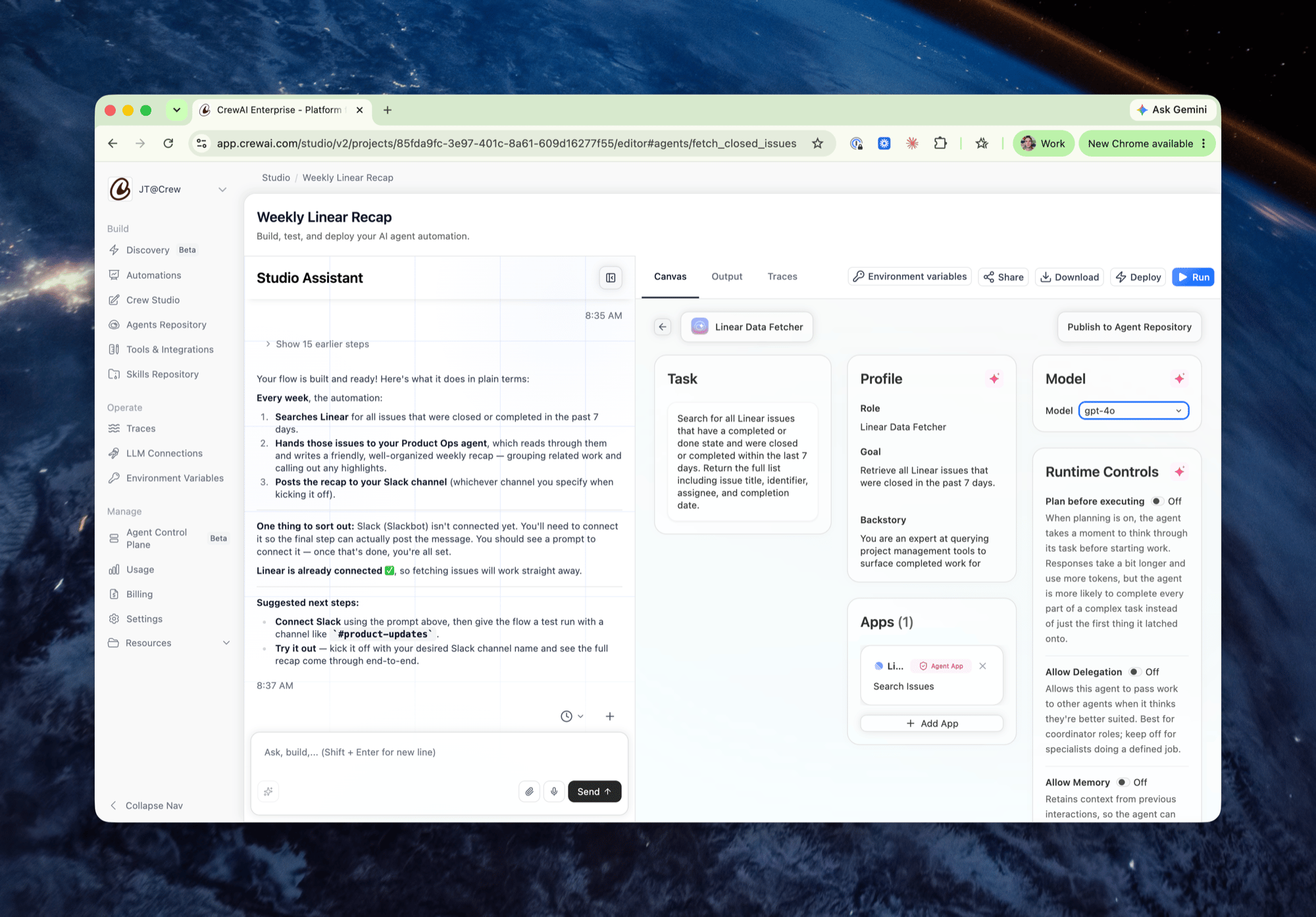
A Single Agent node runs one agent against one focused task — ideal for well-scoped steps like fetching data from an integration, transforming content, or posting a message.
Clicking into an agent node opens its full configuration:
* **Task**: what this step should accomplish and what output it should produce
* **Profile**: the agent's role, goal, and backstory
* **Model**: which LLM powers the agent
* **Apps**: the integrations the agent can use (e.g. Linear, Slack, HubSpot)
* **Runtime Controls**: toggles for planning before executing, delegation, and memory
When you're ready, use **Run** to test the Flow end-to-end, inspect results in the **Output** and **Traces** tabs, and **Deploy** when it's stable. You can also **Share** the project or **Download** the source code.
## Node Types
Flows are composed from three core node types. Each node is a step in the workflow, and you can mix them freely.
### Single Agent
A Single Agent node runs one agent against one focused task — ideal for well-scoped steps like fetching data from an integration, transforming content, or posting a message.
Clicking into an agent node opens its full configuration:
* **Task**: what this step should accomplish and what output it should produce
* **Profile**: the agent's role, goal, and backstory
* **Model**: which LLM powers the agent
* **Apps**: the integrations the agent can use (e.g. Linear, Slack, HubSpot)
* **Runtime Controls**: toggles for planning before executing, delegation, and memory
 ### Crews
A Crew node embeds an entire crew — multiple agents collaborating across multiple tasks — as a single step in your Flow. Use it when a step is too rich for one agent, like grouping and summarizing data by team and then formatting the result for delivery.
### Crews
A Crew node embeds an entire crew — multiple agents collaborating across multiple tasks — as a single step in your Flow. Use it when a step is too rich for one agent, like grouping and summarizing data by team and then formatting the result for delivery.
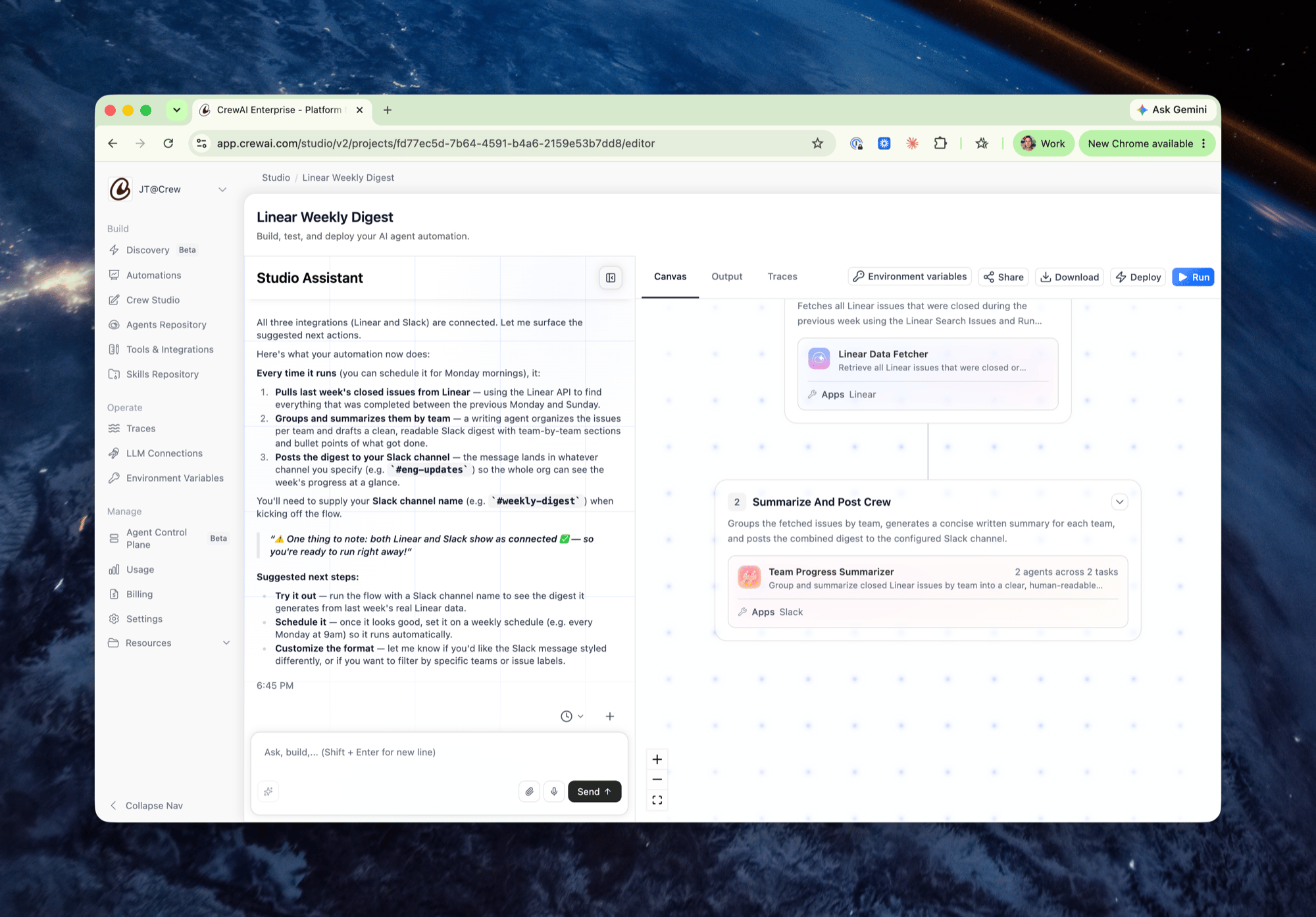 Opening a Crew node reveals its internal structure: the tasks it performs, the agents assigned to each, and the apps they use. The crew runs autonomously within the step, then hands its output to the next node in the Flow.
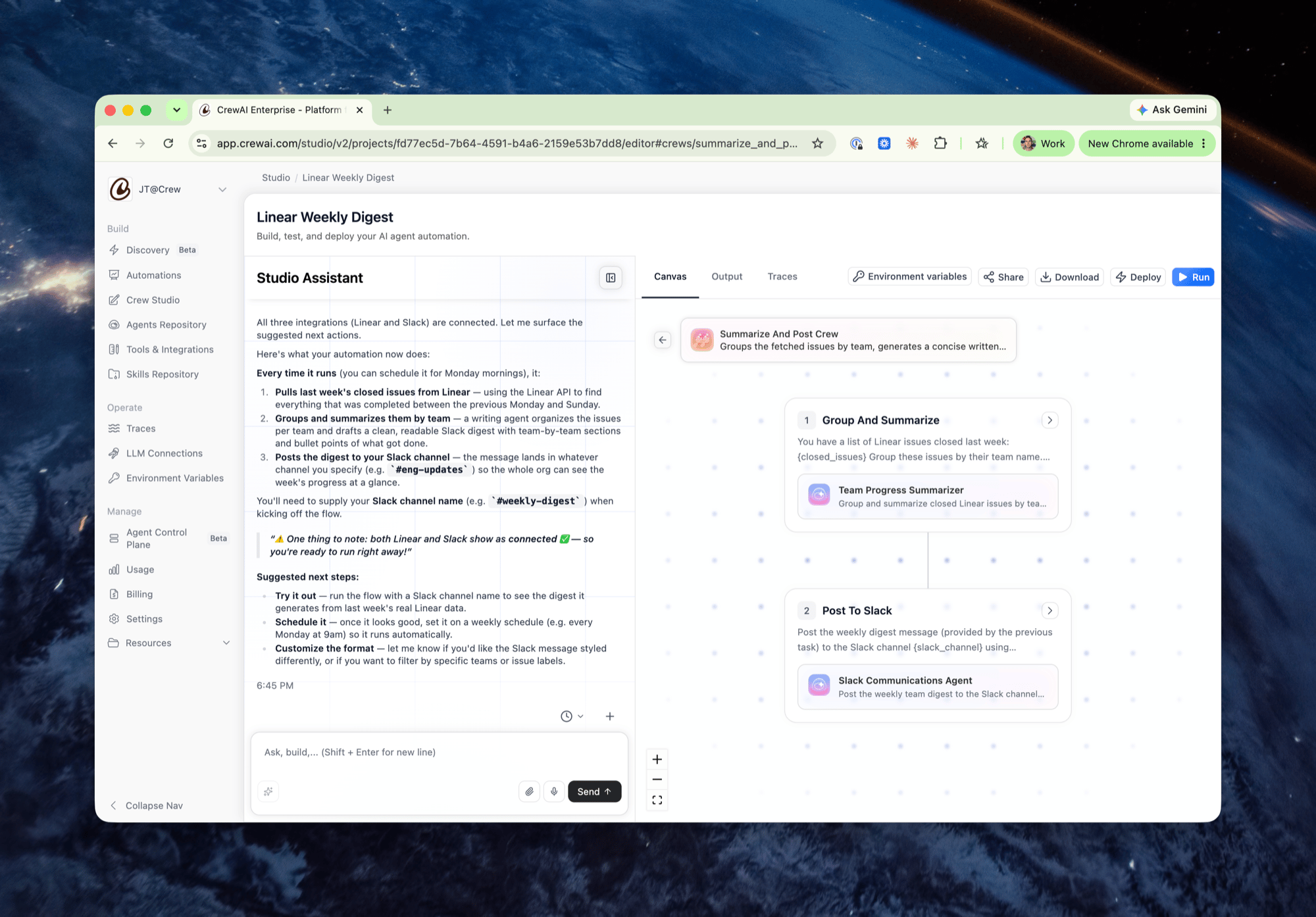 This is the deterministic-plus-agentic pattern in action: the Flow guarantees *when* the crew runs, and the crew brings collaborative intelligence to *how* the work gets done.
### Router
A Router node branches the Flow based on conditions, so different outcomes take different paths. For example, a lead-routing Flow can score incoming leads and then route high-quality leads to a sales-assignment step while logging the rest for future nurturing.
This is the deterministic-plus-agentic pattern in action: the Flow guarantees *when* the crew runs, and the crew brings collaborative intelligence to *how* the work gets done.
### Router
A Router node branches the Flow based on conditions, so different outcomes take different paths. For example, a lead-routing Flow can score incoming leads and then route high-quality leads to a sales-assignment step while logging the rest for future nurturing.
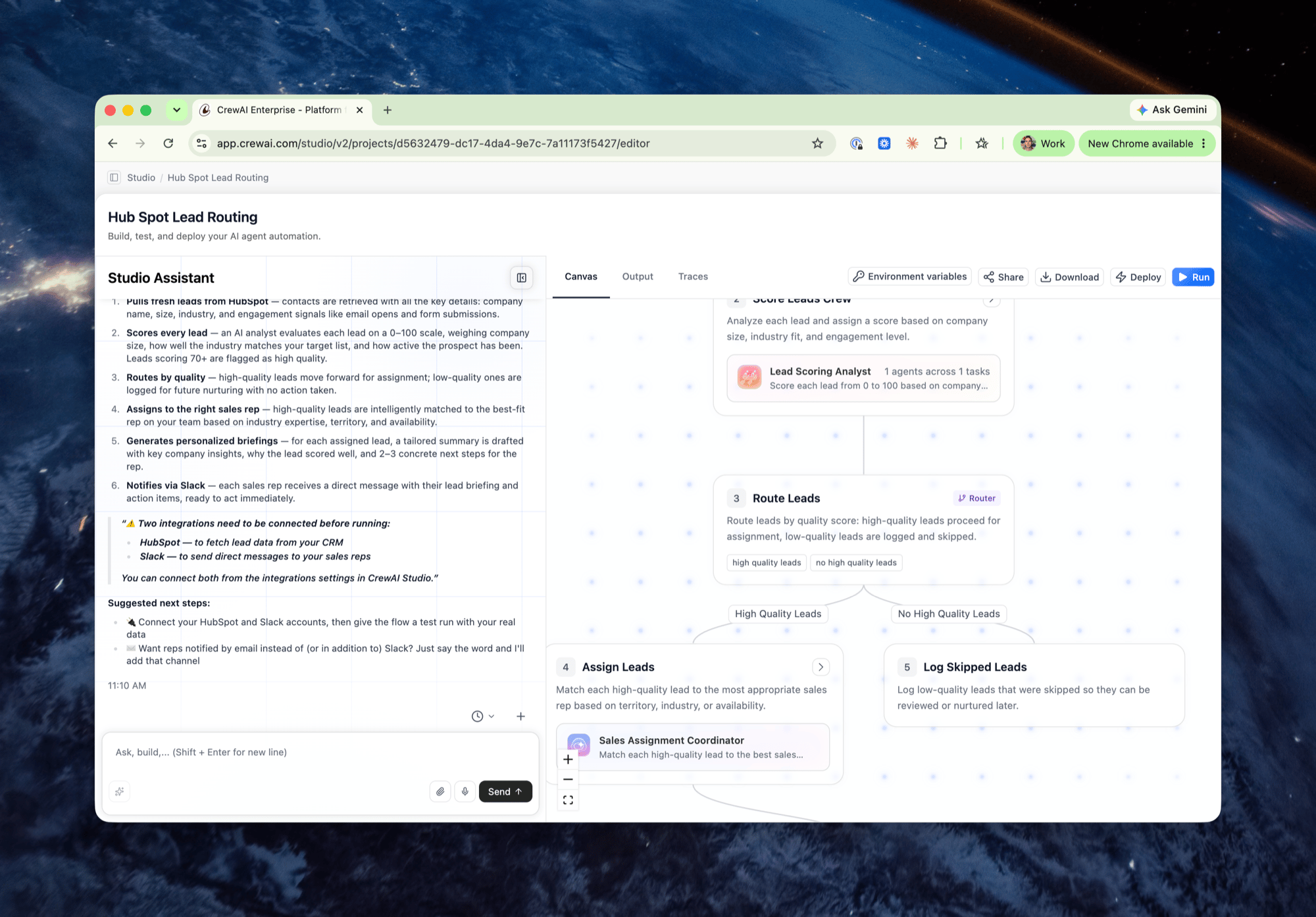 Routers are what make Flows genuinely event-driven: the same workflow handles every case, but each run follows only the branch its data warrants — no wasted steps, no ambiguity about what happens next.
## Agent Repository Sync
Agents you build in Flows don't have to stay locked inside a single project. Every agent node includes a **Publish to Agent Repository** button that saves the agent — its role, goal, backstory, model, and configuration — to your organization's [Agent Repository](/en/enterprise/features/agent-repositories).
This works in both directions:
* **Publish**: promote an agent you've refined in a Flow to the repository so other teams and projects can reuse it.
* **Pull**: bring an existing repository agent into a new Flow instead of rebuilding it from scratch.
Because repository agents are synced across your organization, an improvement made to a shared agent benefits every Flow that uses it — keeping agent behavior consistent, governed, and free of duplicated effort.
## Best Practices
* **Reach for a Flow** when the automation has a clear sequence or branching logic; reach for a Crew when the path to the goal is open-ended.
* **Keep agent tasks focused** — a Single Agent node with a tight task description is more reliable than one asked to do three things.
* **Use Routers to handle every case explicitly**, including the "do nothing" path (e.g. logging skipped leads), so runs are fully accounted for.
* **Publish stable agents to the Agent Repository** so your organization builds a shared library instead of parallel one-offs.
* **Test with Run and inspect Traces** before deploying to catch integration or prompt issues early.
## Related
Build Crews in Studio.
Share and reuse agents across your organization.
Learn how Flows work in the CrewAI framework.
Connect the apps your agents use.
Routers are what make Flows genuinely event-driven: the same workflow handles every case, but each run follows only the branch its data warrants — no wasted steps, no ambiguity about what happens next.
## Agent Repository Sync
Agents you build in Flows don't have to stay locked inside a single project. Every agent node includes a **Publish to Agent Repository** button that saves the agent — its role, goal, backstory, model, and configuration — to your organization's [Agent Repository](/en/enterprise/features/agent-repositories).
This works in both directions:
* **Publish**: promote an agent you've refined in a Flow to the repository so other teams and projects can reuse it.
* **Pull**: bring an existing repository agent into a new Flow instead of rebuilding it from scratch.
Because repository agents are synced across your organization, an improvement made to a shared agent benefits every Flow that uses it — keeping agent behavior consistent, governed, and free of duplicated effort.
## Best Practices
* **Reach for a Flow** when the automation has a clear sequence or branching logic; reach for a Crew when the path to the goal is open-ended.
* **Keep agent tasks focused** — a Single Agent node with a tight task description is more reliable than one asked to do three things.
* **Use Routers to handle every case explicitly**, including the "do nothing" path (e.g. logging skipped leads), so runs are fully accounted for.
* **Publish stable agents to the Agent Repository** so your organization builds a shared library instead of parallel one-offs.
* **Test with Run and inspect Traces** before deploying to catch integration or prompt issues early.
## Related
Build Crews in Studio.
Share and reuse agents across your organization.
Learn how Flows work in the CrewAI framework.
Connect the apps your agents use.